
Live-fire training is a daily reality for active-duty and reserve military units to federal agencies, the National Guard, and state and local law enforcement. These users do not fire ammunition in limited amounts and instead expend thousands of rounds during a single training cycle. The result is a large and continuous stream of spent brass that must be managed under strict property, safety, and accountability rules.
This is where demilitarization (demil) enters the process. Before brass can leave many military installations, it must be physically crushed or flattened so it can no longer be reloaded. Law enforcement agencies are not always legally required to demilitarize spent casings, but many adopt the practice as a matter of policy and risk management.
The work is typically done with roller mills that collapse the casings’ structure, flattening them or partially cracking them so they behave more like solid scrap.
“The operating principle is straightforward,” says recycling expert John Neuens, industrial consultant at BCA Industries. “Brass casings are fed continuously into a pair of counter-rotating steel rollers. The rollers are set with a controlled gap that is narrow enough to crush and flatten the casings without excessively fragmenting them.”
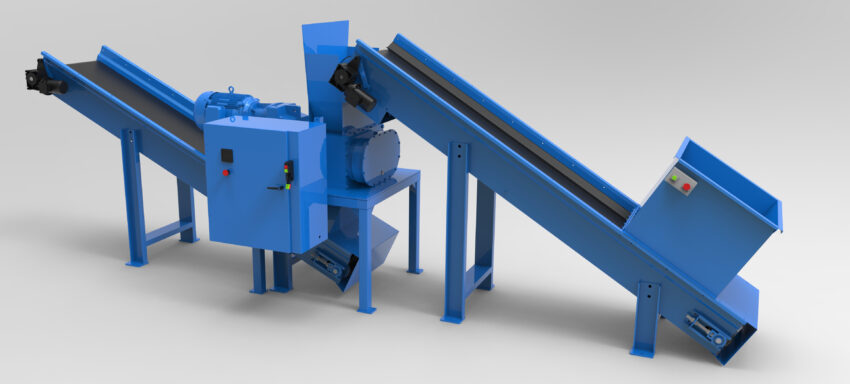
BCA’s Cartridge Crusher RLLR-4001-0001 Roller Mill is an industrial-grade solution engineered to streamline the processing of spent ammunition casings. Built with a robust dual-roller system, the machine compresses and crushes spent shells quickly and consistently.
Manufactured entirely in the United States, the RLLR-4001-0001 features a generously sized hopper capable of accepting a wide range of casing sizes from .22 caliber through .50 caliber.
Although crushing spent brass casings is a relatively simple process, there is always the possibility that an unfired round could enter the recycling stream. The concern is that a live cartridge could discharge under pressure and create a safety hazard.
According to Neuens, safety considerations remain critical in systems handling cartridge brass. However, the equipment is specifically engineered with internal baffling to safely process material even in the presence of live rounds, minimizing risk.
The roller mill is also available in scalable configurations, allowing it to be engineered as a compact, self-contained mobile unit without compromising performance or functionality. https://www.youtube.com/watch?v=6rCNguzqccw
BCA provides complete custom recycling systems for complex industrial and commercial applications. The company serves the U.S. Army and Air Force, as well as some of the world’s largest recyclers.
For more information: call 414-353-1002; fax 414-353-1003; email john@bca-industries.com; visit www.bca-industries.com or write to BCA Industries, 7036 N Teutonia Ave., Milwaukee, WI 53209.