In the aerospace manufacturing program at the Cherry Creek Innovation Campus (CCIC) in Centennial, Colorado, high school students can explore the technical skills behind high-demand careers in modern manufacturing. The program is part of a broader curriculum that also includes veterinary medicine, welding, heating and air conditioning, film and motion design, advanced electronics, baking and pastries, emergency medical technician training, and auto mechanics and manufacturing.
As part of the aerospace manufacturing program, which began in 2018, students gain valuable hands-on experience on real manufacturing equipment.
One rotation focuses on CNC machining with full-size equipment, including Haas mills, three-axis machines, a fourth-axis machine, a CNC lathe, and, more recently, a five-axis machine. The other focuses more broadly on manufacturing fundamentals such as 3D printing, plastic injection molding, routers, plasma cutters and waterjet cutters.
Gabriel Roussere, who teaches the manufacturing fundamentals portion of the program, says that during a semester, teams of two students typically spend about three class periods, or roughly six to seven hours, working through a rotation.
For the plastic injection molding rotation, for example, students learn background information about the machine and the injection molding process, complete short assessments, run a practice mold, and learn how to heat the machine, inject material and remove a finished part.
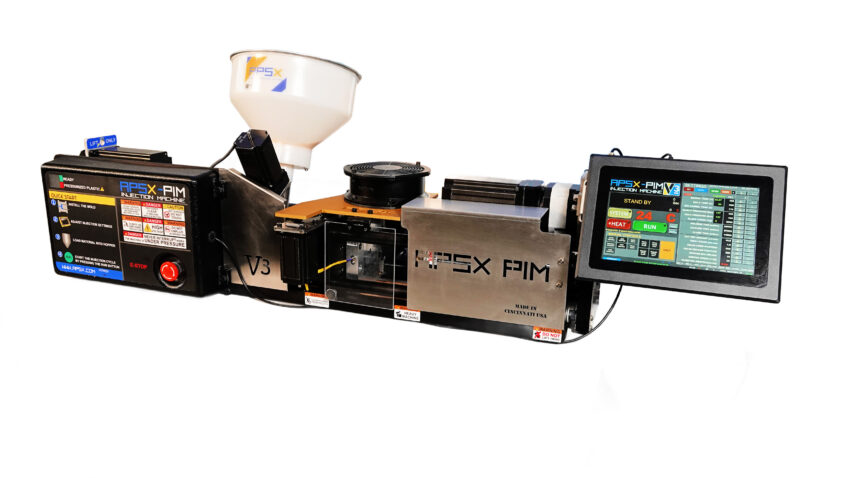
In the classroom, two APSX-PIM machines are used for student rotations. APSX is a company that provides benchtop plastic injection molding systems that deliver many of the production capabilities expected from full-scale injection molding equipment without the capital investment and operating burden.
The APSX-PIM measures approximately 4 ft. × 1 ft. and is small enough to sit on a countertop or workbench and runs on standard wall power, making it much more manageable for a high school manufacturing lab than a full-scale system.
Despite its size, the APSX-PIM supports repeatable molding cycles, consistent part quality, automated operation, controlled injection and clamping functions, and the use of production-grade thermoplastic materials and molds.
Roussere says the benchtop equipment serves as a practical training platform, helping students develop a clearer understanding of resin selection, processing parameters, cycle optimization, part quality evaluation, and basic troubleshooting. Having two machines gives the program more flexibility when multiple students or groups are working on projects at the same time.
“It’s automated, but it’s hands-on enough that the students have to do a little bit of work to get it ready,” says Roussere.
Roussere sees the APSX-PIM as a strong option for other high school and college technical education programs when the goal is to introduce students to injection molding without the cost, footprint or complexity of industrial-scale equipment.
“If you’re in a high school or college manufacturing program and you want to do an introduction to injection molding, it’s a great machine,” says Roussere.