
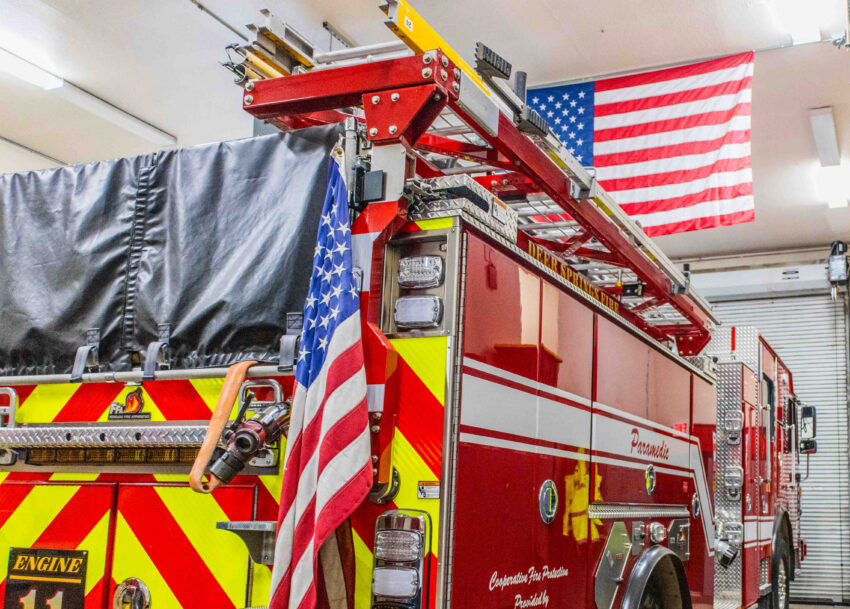
Designed for speed rather than wellness, legacy fire station alerting systems rely on loud tones, harsh lighting, and station-wide wakeups. Although many of these systems continue to perform reliably for decades, they have also disrupted sleep cycles, elevated stress hormones, and contributed to longterm fatigue.
“Historically, fire station alerting systems in the past were very loud,” says Battalion Chief Thomas Shoots of the Deer Springs Fire Protection District. “The whole idea was to get everyone’s attention and after decades of that, it takes a toll. There are other ways to get attention without just being loud.”
As District Chief, Shoots is responsible for the day-to-day fire and EMS operation in Deer Springs, including station readiness, response capability, and coordination with CAL FIRE.
Now a new generation of fire station alerting systems is improving communications reliability while adding capabilities such as selective alerting, text-to-voice announcements, redundant communications paths, and highly configurable station notifications.
A Rebuild Creates an Opportunity
When Deer Springs rebuilt Station 2 “from the foundation up,” fire leadership saw a chance to rethink how firefighters are alerted – not just how fast. One of three stations in the district, Station 2 is a busy rescue station with an urban search and rescue vehicle and a swiftwater rescue team that can grow during elevated weather risks.
Several years earlier, the district had upgraded its other stations to a modern fire station alerting (FSA) system from RadioMobile, a San Diego-based company that provides life-saving technology solutions for the fire service.
RadioMobile’s IQ Fire Station Alerting System is activated automatically upon receipt of a dispatch message. When a 911 call is processed and dispatched, the information is sent to the station over an IP network or, in some cases, over radio. In an IP-based system, the message is forwarded to the command desk terminal, which extracts the information needed to alert the right personnel, activate the appropriate station devices, and sends the information to firefighters.
The station control unit receives the instructions and activates lights, speakers, timers, remote displays, and other devices throughout the firehouse. It also manages inputs from acknowledgement buttons, doorbells, and emergency buttons located throughout the station.
Automated messaging ensures both higher consistency of messages and accuracy because the digital message can be converted into text-to-speech, which results in all stations hearing the same voice, cadence, and delivery on each call. This reduces variability from live dispatcher audio such as fatigue, accent, time of shift, and clarity of speech.
Another key capability is selective, or zone-based, alerting. Instead of waking the entire station for every call, the system can alert the rooms and crew areas tied to the units assigned to the incident. Tones ramp up gradually instead of blasting awake a sleeping station. Visual indicators such as red for engines, yellow for trucks, blue for medics, green for brush rigs, provide instant clarity.
“Having a modern system allows us to be more thoughtful and targeted with how we are doing dispatches,” says Shoots. “That’s a huge thing when we are looking at the health and wellness of our crews and trying to ensure they get as much rest and sleep as possible.”
For more information, contact Ron Lyons at RadioMobile by phone at (619) 855-7041, by email at Rlyons@radiomobile.com, or by mail at 8801 Kenamar Drive, San Diego, CA 92121.