Businesses such as e-commerce sellers, retailers, and manufacturing companies, have been actively seeking alternatives to standard adhesive shipping labels.
Secondary packaging plays a significant role in marketing and branding strategies. In addition to safeguarding primary packaging, it provides a golden opportunity for companies to showcase their brand identity, logos, slogans, and promotional messages, thus attracting the attention of potential customers. By carefully considering the secondary packaging design and shipping methods, ecommerce retailers and shippers can differentiate themselves from their competitors and increase the likelihood of customers choosing their products.
This applies, of course, to the traditional adhesive labels used on bags.
Labels have significant disadvantages including being an enormous source of environmental waste. Most adhesive labels are not recyclable and can contaminate the box or bag such that it is no longer recyclable. Plus, there is an added cost associated with label stock and printing.
Shippers and e-commerce retailers are increasingly exploring alternative solutions that are more sustainable and eco-friendlier. This includes eliminating the need for a traditional adhesive label by printing directly on secondary packaging using high-speed inkjet systems.
David Loos from MCS, a leading supplier of high-speed mail manufacturing equipment since 1989, says they were approached last year for a solution that would print trackable variable barcodes directly on shipping bags. Many larger bag suppliers invest in high tech manufacturing equipment to offer cutting-edge bag solutions, including modern bag designs in many shapes, variations, and types of substrates. The bags are used by ecommerce sites for shipping, and online retailers that offer home delivery services.
For high-speed printing, roll-feed flexographic printers are utilized. The paper rolls are then cut into sheets at approximately the same speed. The concern was whether direct-to-bag printing systems could keep up. The average inkjet printer operates at a speed of 105 to 500 feet per minute. However, MCS has printers that can reach speeds of up to 1,000 feet per minute.
“We print on a wide web at very high speeds and there are very few [direct print inkjet] machines that can run at a thousand feet per minute and print the high-quality tracking codes at that speed,” says Loos.
Although the bag is printed on a flexographic printer, space is available on the press to add an inkjet printer for direct printing of tracking codes and “just about anything else you can think of,” according to Loos.
“Instead of a label going on that affects the cost and affects the recyclability of the product, we can now digitally print that unique code directly on the bag using the MCS printer,” says Loos. “We can print anything the customer wants, including notifications about store openings in their area, special offers, links to sales or other sites, or other promotional messages.”
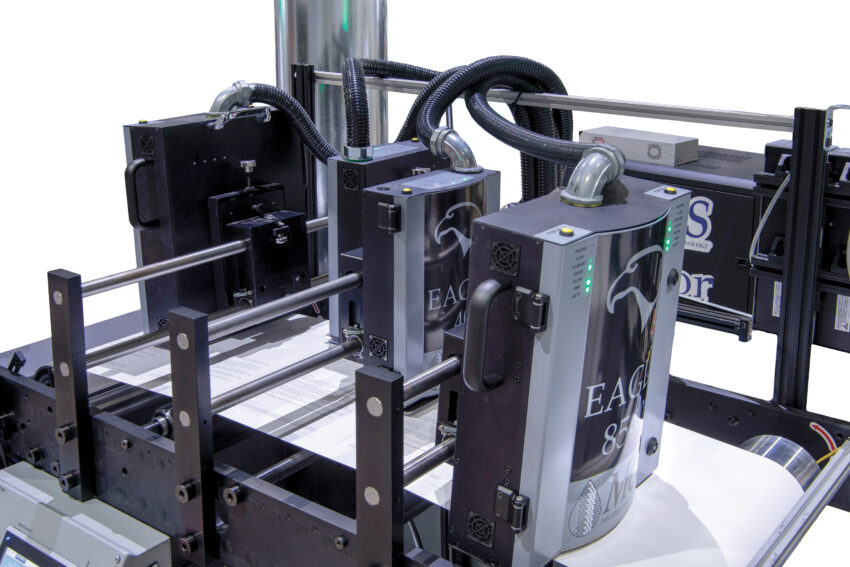
The equipment used is one of the fastest inkjet printers in the industry, the MCS Hayabusa Inkjet, that delivers print widths from 4.25 to 34 inches. MCS offers other direct-to-packaging alternatives at different speeds and price points. This includes inkjets that can apply process color and monochrome printing horizontally or vertically. The inkjet printer comes with MCS’ Raptor software, which manages the custom messaging and variable data seamlessly with any printing solution required.
According to Loos, the speed of the printing and the elimination of the need for a label are the primary benefits of such systems.
“Label applicators are not nearly fast enough to keep up with a flexographic printer. One printer may serve six or seven bag machines, and that would require six or seven label applicators,” says Loos. “With direct printing, no applicators are required. This approach also reduces the costs of the bags.”
Loos believes that direct printing to bags or boxes will have many applications in the future now that the primary barrier – speed – is no longer an issue.
“I think there is a very good potential to offer printing directly packaging, not just for QR or barcodes, but for promotional statements, says Loos. “The ecommerce retailer or home delivery service can really choose exactly how they want to use it.”
For more information on MCS and their inkjet printing solutions, visit www.mcspro.com, call 800-728-0154 or email erica.dangelo@mcspro.com.